The Most Important Thing You Will Ever Do: The Art of Living Authentically
For thousands of years, thought leaders have stated in one way or another that authenticity is essential to well-being.
Greek Philosopher, Plato suggested that above all else, we should know our self.
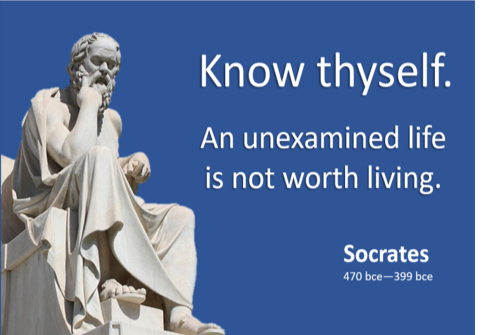
Socrates observed that “an unexamined life is not worth living.”
Shakespeare wrote, “This above all; to thine own self be true.”
Emerson observed, “To be yourself in a world that is constantly trying to make you something else is the greatest accomplishment.”
In more recent times, Maxwell Maltz wrote, “Self-image sets the boundaries of individual accomplishment, and determines what we become.”
For what we become to be fulfilling, it has to be authentic… true to who we came into this world to be. There is nothing more beneficial than knowing who we really are, and expressing our truth honestly and with integrity.
Some people present a false front because they are afraid people won’t accept their real self. Some live behind a mask because they perhaps fear hurting someone’s feelings or damaging a relationship, or creating conflict, or embarrassing themselves. But most people present a false front because they don’t know their own truth. And, not knowing, they are compelled to make assumptions based on the feedback they get from people who also have no idea who they are.
We can’t be authentic when we are living out of integrity and we can’t live in integrity if we don’t truly know ourselves. Authenticity begins with truly knowing oneself. Until we can see our own truth, we cannot present a true picture to others.
What is the truth? The truth is that no one is perfect and no one is broken. Both perfection and imperfection are simply judgments which few agree upon. Those who look for the good in self and others can always find it, and those who look for flaws can always find flaws.
When we are open to the fact that everyone has good qualities and everyone has flaws, we stop judging and become discerning. Discernment is the ability to consciously observe the entire picture and make wise choices based on that more complete view. It’s the ability to purposefully select the actions we take, and the associations we make based on the whole picture.
Living a life of integrity is not as hard as it seems, but it takes dedication and determination to “know thyself” authentically to live in alignment with the self we came into the world to be.
People who live in integrity find that others respect and trust them more. They seek their feedback because they know it will be honest. Beyond the positive effect on relationships, there is the positive effect on self. When we are living in integrity, we are happier and more satisfied with our lives. We feel comfortable and guilt-free because we have nothing to hide.
Have you ever assessed how honest you are? Most people lie, or at least omit the truth, on a regular basis. They hide their thoughts and feelings about what’s happening around them. They say nothing when others are acting offensively. They tolerate bad behavior in others. Why?
Let’s explore that, along with the long-term consequences, and also what it’s like to be genuine and real.
Most people see themselves as basically good people. Even hardened criminals often say that they are basically good people who just made some bad decisions. Almost 100% of people in the general population indicate that they see themselves as basically honest, stating… “I only lie when I have to”.
So what is integrity? What does it mean to live a life of integrity? What are the social and psychological effects of not doing so? The Comprehensive Dictionary of Psychological and Psychoanalytical Terms defines integrity as “the quality of being whole or undivided; moral consistency; honesty and truthfulness.”
By this definition, living with integrity absolutely requires knowing one’s true self. How else can we be whole or undivided? We are continuously bombarded by forces that make living with moral consistency, honesty and truthfulness challenging and, if we don’t know who we are and what we stand for, those outside forces can keep us eternally off-balance, doubting ourselves, wondering if their opinions and expectations are more valuable than our own.
Most people have a sense of what it would mean to live their life with integrity. Most have a picture of their “ideal self” in their minds. Yet, most people also frequently find themselves falling short of that ideal.
When we make decisions that give immediate, albeit temporary, satisfaction, but that don’t leave us feeling good about ourselves. We fall out of integrity.
In order to live with integrity our actions must align with our true self and our core values and beliefs so that our choices and behaviors consistently reflect our truth.
For most people, the challenge is maintaining integrity in a society that doesn’t necessarily reflect the values we hold. It’s a lot easier to stay in integrity when the larger society reflects, supports and encourages our values. Unfortunately, most societies don’t operate from high standards, and people who try to operate at that higher level are often viewed as unrealistic or out of touch with reality.
When greed and selfishness begin to rule a society, it’s easier to just go along. When a society glorifies ruthless people who they view as “successful”; when it admires people who get away with something; when it places a greater value on bottom line profits, material possessions, end results, and winning at any cost, consistently living in an honest, considerate, high integrity space is a real challenge. But what is the price we pay when we don’t?
People spend millions of dollars every year going to therapists hoping to gain relief from anxiety, panic, depression, and a long list of other maladies. Generally, they are seeking to change ineffective behaviors or habits. They state that they want to live happier, more productive and fulfilling lives. They intuitively know that something is missing; they don’t feel whole. There are parts of themselves that they don’t like and want to get rid of.
Many psychologists describe individuals who are estranged from themselves and the life they are living as living from a “false self” in order to cope with the world. Those who follow the philosophies of Swiss psychologist, Carl Jung, understand the human drama as primarily a quest for the real self. Along with the Greek philosophers, Jung believed, and rightly so, that people have psychological health to the degree that they live an authentic life.
Generally, the human struggle is a search for meaning in an absurd world. Positive psychologists, such as Abraham Maslow and Martin Seligman, suggest that much of what we call psychopathology is the result of inauthentic behaviors and ineffective coping mechanisms that result from functioning from the false-self, and trying to find meaning in the world from that inauthentic space.
The existential philosopher Jean Paul Sartre used the concept of bad-faith, to refer to the degree to which people fail to develop their potential as human beings. He suggested that we all live in bad-faith to some degree since we are not able to develop all of our potentialities and express them honestly at all times. He asserts that, to the extent that we struggle to live an integrated, authentic life, we more closely approach good faith, and points out that the more complex the society, the more difficult it is to live an integrated, authentic life.
Difficult, perhaps. But certainly not impossible.
Integrity and Mental/Emotional Health
When we seek expedient solutions to complicated problems, we are seeking short-term fixes rather than long-term solutions. We often come up with all sorts of excuses for why it is acceptable for us to do what we are doing despite the consequences. We know that we are not living up to our highest potential. We know that we are falling short of our ideal self. Some people excuse this by saying that living an authentic life is not practical. They assert that we all have to live less than honorably at times if we want to survive or be successful in this world. They fail to see that short-term, so-called “practical” solutions to the complexities of modern life only bring more grief, pain, and distress in the long run.
Some people seek some form of therapy hoping to find a way to live without integrity and the painful consequences. Some seek relief through antidepressants or anti-anxiety medications hoping to dull the pain of living an inauthentic life just enough to get by. But no form of therapy and no medication can heal or cure the malaise or anxiety created by living an inauthentic life.
Psychiatrists that approach therapy from a biological perspective assert that the maladies people experience are the result of a chemical imbalance. They are looking at it backwards. The negative effects of living inauthentically are not caused by a chemical imbalance. A chemical imbalance occurs as a result of living inauthentically. Chemical imbalances in the brain are almost always an effect, not a cause.
Many of the symptoms of mental and emotional stress with which people struggle and for which they seek therapy or medication are exacerbated, if not caused, by living inauthentic lives.
Though people enter psychotherapy wanting to feel whole, fulfilled and content with their lives, they are generally also trying to avoid doing the work of changing old, familiar but ineffective patterns. They fail to see the connection between how they live their lives and the emotional consequences they experience. Unfortunately, so do most therapists.
Mental health professionals too often attribute emotional pain solely to childhood conditions, such as poor parenting; a chemical imbalance, or unresolved traumas and such. While it is true that these can significantly contribute to emotional distress, it’s the way in which we live our lives that contributes most to how we feel about ourselves. Yet, the role of authenticity receives scant attention by many mental health professionals, which may explain why traditional therapeutic approaches often fail to yield the desired result.
People who are aware of themselves; who have taken the time to examine their life, are familiar with the discomfort they experience when they act in ways that run counter to their true self and core values. Depending on the magnitude of the transgression, they may lose sleep, condemn themselves, lose concentration, or become anxious or depressed. Most people notice these responses when a transgression is significant, but when there are a series of smaller transgressions spread out over time, the growing pain is often ignored until it becomes a crisis.
Research strongly suggests that the negative effects of living an inauthentic life build up over time, gradually eroding our sense of well-being. Most people find all kinds of ways to ignore the growing unease. They tell themselves that everybody feels that way. They make excuses, rationalize, find more and more ways to distract themselves, but the effects continue to build. Like the little spot of rust on a car, when we ignore the problems, they just keep spreading, gradually eroding our sense of self and capacity for enjoyment of life.
Examine Your Life
In a normal week, how many times do you:
- Tell someone you feel “fine” when you really don’t?
- Allow someone to inconvenience you, frustrate you, or get in your way to avoid conflict?
- Tolerate bad behaviors in others
- Smile and nod in agreement with something you don’t really agree with, or remain silent?
- Compliment someone to make them feel better, rather than because you feel a genuine desire to compliment them?
- Help someone out without asking for anything in return, when what you contributed was big enough to warrant a favor in return?
Hide your feelings or tell lies for any of the following reasons:
- To keep a situation stable
- To avoid confrontation and conflict
- To prevent someone’s feelings from getting hurt
- To keep information confidential to ensure someone’s privacy
- To avoid having to explain yourself or defend your actions
You may be wondering what’s wrong with any of this. You may see behaving this way as just being nice. You might think that’s what people should do; that such reactions are a sign of high social intuition and emotional maturity (EQ). They aren’t. Such behaviors are just attempts at side-stepping actions that would provide long-term benefits, in favor of short-term relief. When we avoid stating our truth, holding true to our values, and acting in ways that align with our authentic self, we are living out of integrity, and the consequences are far greater than most people even begin to imagine.
“White Lies” Have Negative Consequences
Hiding our negative feelings in reaction to something someone does or says to keep the peace and avoid unnecessary conflict may seem like a legitimate strategy, but what we are actually doing is condoning something we believe to be negative or unhealthy. And, when we do that, we are failing to provide helpful feedback. We are teaching people that such behaviors are acceptable.
If, for example, a friend or coworker makes a racist remark or tells a vulgar joke, and you don’t say anything, the feedback you are giving is that it’s okay to be racist or vulgar. Essentially, you are reinforcing that behavior. And you can be sure that, if you never challenge distorted views and inappropriate behaviors, at some point those who get by with such behaviors will offend someone, and those who have remained silent will have contributed to that outcome.
“The foundation stones for balanced success are honesty, character, integrity, faith, love and loyalty.”
– Zig Ziglar –
The Safe Way to Be Honest
Many people justify dishonesty by telling themselves that honesty can create conflict. And it certainly can if it is presented bluntly and without finesse, but if you take the time to think things through and present your views and feelings appropriately, the results will always be beneficial.
That is not to say that the other person will always appreciate your honesty. Often, they won’t. But that isn’t the point. The point is that the long term effect is that you will feel good about yourself and you will have given beneficial feedback to the other person. We can’t control how the other person will receive our feedback, but we can completely control how we give it.
Obviously, it’s inappropriate on your part to blurt out something like, “That’s ridiculous! You’re acting like an idiot!” That is not beneficial feedback. It’s a harmful opinion. It’s important to be diplomatic and respectful as well as honest.
It takes dedication and regular practice to express ourselves honestly and effectively. Most people need training and coaching to be effective. It’s unwise to try to dive in and start expressing honestly without first learning how to do that in ways that are respectful and considerate.
To learn ways to give feedback effectively and live a more authentic and fulfilling life, read “The High Cost of Living an Inauthentic Life.”